
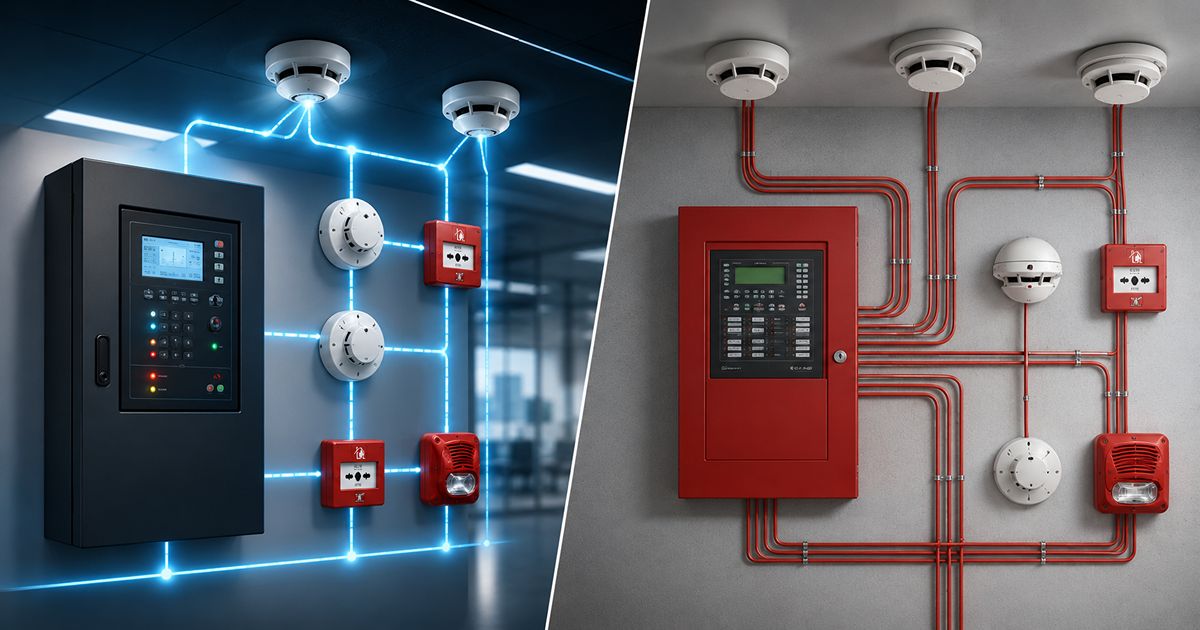
Addressable and conventional fire alarm systems differ mainly in how they identify the location of an alarm.
An addressable setup reports the exact device that sent the signal, while a conventional setup points to a zone that may contain several devices.
Both options can protect a building when properly planned, installed, and maintained. The right choice depends on the property size, layout, budget, and service needs.
An addressable panel communicates with each connected device by using a unique address. A conventional panel identifies the circuit or zone where an alarm started, but it does not identify the exact device.
For example, an addressable panel may display “Smoke Detector 24, Third Floor Storage.” A conventional panel may show “Zone 3 Alarm.” Staff must then inspect every detector and pull station connected to that zone.
This difference affects alarm response, service work, wiring, future expansion, and total cost. Our guide to choosing the right alarm covers other building factors that can shape the selection.
Neither system type is automatically better for every site. I compare the property’s needs first, rather than choosing based only on price or newer technology.
An addressable fire alarm system assigns a unique number to each connected detector, module, and manual station. The panel polls those devices and displays the exact point that reports an alarm, fault, or service condition.
Most addressable devices connect to a signaling line circuit, often called an SLC. The circuit carries power, data, or both, based on the system design.
A technician assigns an address to each compatible field device. That number links the device to a programmed location name inside the control panel.
Common addressable equipment includes:
The ASD-PL3-IV detector is one example of an addressable photoelectric smoke sensor. It combines a photoelectric chamber with analog communication and uses rotary switches for point addressing. Honeywell states that the ASD-PL3 family sends an analog representation of smoke density to a compatible panel.
A Notifier FSP-951 also provides individual device addressing. Its sensitivity can be programmed through supported panel software, while the panel tracks and reports the sensor level.
Brand names do not prove that two addressable products can work together. Each device must support the panel protocol, the approved base, the voltage range, and the system listing.
Addressable equipment provides more information than a simple open- or closed-circuit state. Available data may include:
Functions vary by panel and product family. We always check the manufacturer documents before replacing a field device.
A panel can also use modules to connect supervised circuits or outside equipment. The Edwards SIGA-CT2 is a dual-input module used with compatible Signature Series systems. Modules like this allow a panel to monitor devices or circuits that need addressable point reporting.
An address alone may appear as a number, such as “Point 042.” Good programming adds a plain location label.
A clear label might state:
“East Wing Electrical Room Smoke”
That message provides staff with useful guidance during an alarm. Poor labels can waste the speed advantage of an addressable system.
A conventional fire alarm system groups initiating devices into zones. When a device changes the circuit condition, the panel reports the affected zone rather than a specific point.
Each zone usually covers a defined part of the property. A small office may have one circuit for the first floor and another for the second floor. A larger site may divide areas by hall, wing, or use.
Several detectors or pull stations may be connected to a single initiating device circuit. The panel supervises that wire for normal, alarm, and trouble conditions.
When a smoke detector activates, the panel knows which circuit changed. Staff still need to inspect the connected area to find the source.
Zone labels must remain clear. A name such as “Zone 2” offers little help by itself. “Second Floor Offices” gives staff a useful search area.
Conventional systems often require more home-run circuits as the number of zones grows. Each circuit returns to the panel or expansion hardware.
This setup can remain simple in a small building. Wiring needs may rise fast in a property with many floors, rooms, or separate fire areas.
Conventional notification appliance circuits can power horns, strobes, or combined units. Our article on horn strobes in noise explains why visible and audible signals both matter in busy spaces.
Addressable systems provide exact point details and advanced device data. Conventional systems provide zone-based reporting through a simpler circuit layout.
| Feature | Addressable system | Conventional system |
| Alarm location | Exact device | General zone |
| Device communication | Unique digital address | Shared circuit state |
| Fault finding | Point level detail | Zone inspection |
| Initial equipment cost | Often higher | Often lower |
| Expansion | More flexible on supported loops | May require added circuits |
| Programming | More detailed | Usually simpler |
| Device compatibility | Protocol specific | Circuit and panel specific |
| Best fit | Larger or detailed sites | Smaller, simple properties |
The lower purchase price of a conventional panel does not always mean a lower lifetime cost. Added wiring, longer service visits, and later expansion can change the full budget.
Our review of cost versus safety explains why price should be compared with system fit, support, and long-term service needs.
An addressable system usually gives staff a more exact starting point. Its panel can identify the programmed location of the active device.
A conventional panel may still report an alarm right away. The difference appears in the location detail. Staff may need to search several rooms within the reported zone.
Faster point identification can help in:
Building procedures still matter. A detailed panel message provides little value when labels are old, staff lacks training, or floor plans do not match the current layout.
An addressable fire alarm system often has a higher equipment and programming cost. A conventional system may cost less for a small property with few zones.
The full project price can include:
Addressable loops may reduce some wiring needs because many devices share a communication circuit. Conventional systems may need separate cable runs for added zones.
Still, no fixed rule fits every building. A site survey and code review provide a better cost picture than a price check on the panel alone.
Common replacement stock can also affect operating costs. Our list of parts buildings should stock covers useful spares that may limit service delays.
Addressable systems can make fault finding easier because the panel identifies a specific point. Conventional systems may require more testing across every device on the reported circuit.
For example, an addressable panel may show a dirty smoke detector in one office. A conventional panel may show a zone trouble, requiring circuit checks before the faulty part is found.
Addressable maintenance can still require more training. A technician must understand:
Conventional service may feel simpler, but poor zone records can slow the work. Clear drawings and current labels help both types.
A building should also keep key system items in serviceable condition. This article on the common commercial parts shows how detectors, modules, pull stations, notification devices, batteries, and panel parts work together.
Addressable and conventional devices can sometimes operate in a single system via listed interface modules or compatible panel circuits. They cannot be mixed at random on the same wire.
An addressable monitor module may supervise a conventional contact or initiating circuit. The module then reports that circuit through its unique address.
The panel will identify the module point, but it may not identify each of the conventional devices behind it. For example, one module could supervise several conventional contacts and report them as a shared input.
Every mixed design must follow:
Never connect a detector based only on wire count, base shape, or voltage. Similar-looking devices may use different communication methods.
A conventional system may work well in a small building with a simple floor plan and few alarm zones. It can provide clear area reporting without the added cost of point programming.
Possible sites include:
Room count matters more than square footage alone. A compact building with many locked rooms may gain more value from exact point identification than an open warehouse of the same size.
Manual alarm stations also need proper placement and system matching. Our guide to pull station brands explains common product families and compatibility concerns.
An addressable system often suits a large property with many devices, rooms, and floors, as well as future growth plans. Exact point reports can speed service and reduce the area staff must inspect.
Good candidates often include:
Addressable systems may also support advanced control functions. These can include elevator recall, air handling shutdown, door release, suppression supervision, and networked panel reporting.
Newer platforms keep adding better data, remote tools, and connected service options. Our article on future alarm trends reviews several changes affecting modern fire protection equipment.
Choose a system by reviewing the building, required functions, plans, and approved equipment. Do not base the choice on panel price alone.
Use these steps before making a decision:
I also recommend checking product availability before selecting an older platform. A system may work well today but become costly when listed replacement parts grow harder to find.
You can browse our fire alarm shop to compare available detectors, modules, notification units, and related parts. Always match the full part number with approved system records before placing an order.
The most common mistake is choosing a system before reviewing the building layout. A low panel price can hide added wire, labor, or expansion costs.
Avoid these errors:
Our team recommends treating the control panel and field devices as one listed system.
Addressable vs conventional fire alarm systems can both provide reliable protection when the design matches the property.
Addressable equipment gives exact device details and easier point tracking, while conventional equipment offers simple zone-based operation that may suit smaller sites.
Review the layout, wiring, expansion plans, service needs, and approved device list before buying equipment.
A qualified fire alarm professional should complete the design, installation, programming, and acceptance testing.