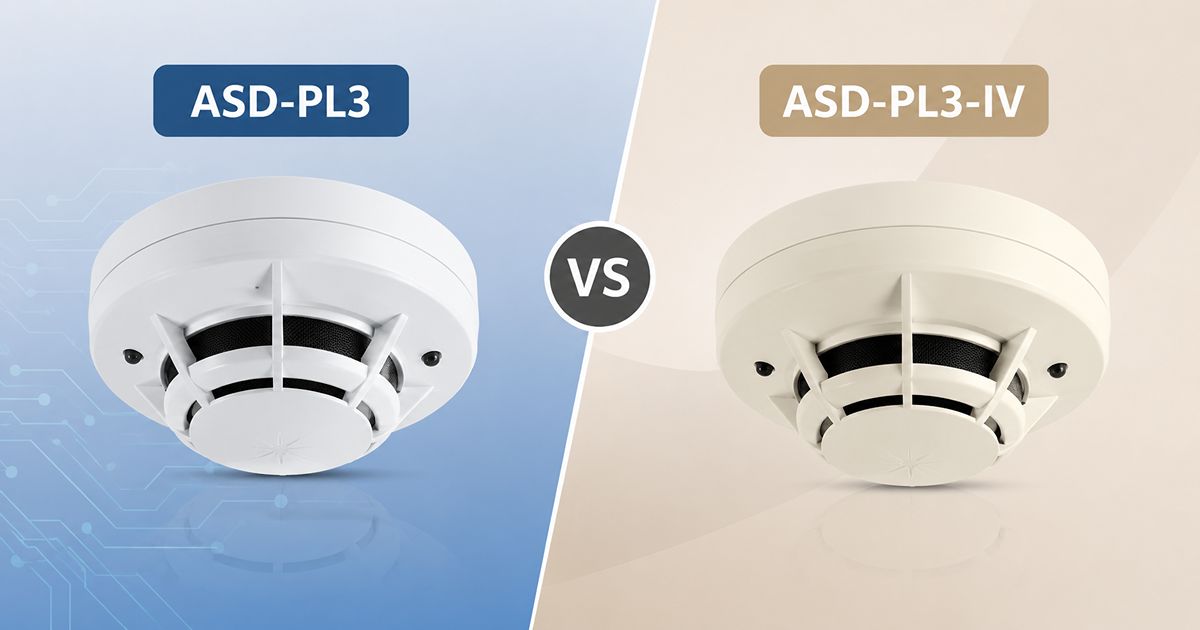
The difference between the ASD-PL3-IV and the ASD-PL3 comes down to two things: housing color and communication protocol.
Both are Gamewell-FCI Velociti Series 3 intelligent photoelectric smoke detectors, and both share the same sensing chamber and the same electrical ratings.
Gamewell-FCI lists the ASD-PL3 as bright white and Velociti.
It lists the ASD-PL3-IV as ivory and Velociti or CLIP, which makes it the service model for older loops.
IV means ivory. On the Gamewell-FCI ordering list, the ivory versions are also the service models, and those are the ones listed to operate in both Velociti and CLIP protocol for backward compatibility.
That is the part most buyers miss. The suffix carries two pieces of information at once, not one.
The same pattern runs across the family, so the ASD-PL3R-IV and the ASD-PTL3-IV follow the same rule as the ASD-PL3-IV.
If you have only ever seen these detectors as a color choice, it helps to review how addressable detectors work before you place an order.
Protocol decides whether the panel hears the device at all. Color only decides how the ceiling looks.
Protocol is the difference that can stop a replacement from working. The ASD-PL3-IV is listed for Velociti and CLIP. The white ASD-PL3 is listed for Velociti.
According to the Gamewell-FCI Velociti Series 3 datasheet, document 9020-0617 Rev K, the E3 Series and S3 Series panels support both Velociti and CLIP protocols.
The same document adds one exception worth writing down: the GWF-7075 panel does not support CLIP.
So the ivory model is not a universal answer. On a 7075, the second protocol gives you nothing extra, because that panel is not going to run CLIP either way.
Gamewell-FCI points installers to the Compatibility Addendum for Gamewell-FCI Manuals, part number 9000-0427-L8, for the full panel list.
Check the addendum and the loop programming before you buy, not after. Panel firmware and loop settings vary by site.
The head and the base ship separately, and the color is set by the base part number. A white detector on an ivory base looks wrong, and an ivory detector on a white base looks worse.
Gamewell-FCI lists matched pairs for both colors:
If your ceiling already has ivory devices, order the ivory base with the detector. Buying the head alone and reusing an old base of a different family is where a lot of service calls go sideways.
Choose the bright white ASD-PL3 when the system runs Velociti on an E3 or S3 panel and the rest of the ceiling devices are white.
There is no performance reason to pay for a legacy service model on a new install.
There are two other cases where neither of these models is what you want.
For a DNR or DNRW duct smoke detector housing where remote test capability is required, look at the R version instead. The ASD-PL3R-IV is the remote test-capable model in ivory.
If the space calls for photoelectric sensing plus a fixed-temperature thermal element, the smoke and thermal version covers that.
The photo with thermal models also carry a narrower operating temperature range than the photo-only models, so check the space before you swap types.
Our team fields this question often, and the same three problems come up.
If you are replacing a discontinued part and the label is painted over or missing, send the panel model and a photo before you order rather than ordering the wrong device.
The fastest way to get this right is to read the part number on the detector you are pulling and check the loop protocol in the panel.
Those two facts decide between the ASD-PL3-IV and the ASD-PL3 in about a minute.
A licensed fire alarm technician should handle detector replacement, panel programming, and acceptance testing, and NFPA 72 governs inspection and testing where your jurisdiction adopts it.
When you know the part you need, you can buy fire alarm parts and matching bases in one order.